

By using this site, you agree to the Privacy Policy and Terms of Use.
Accept
MedsparkMedsparkMedspark
  • Home
  • News & Alerts
    News & AlertsShow More
    Routine CT scans get a second read for hidden bone loss
    By
    msadmin
    October 10, 2026
    Carotid plaque AI flags stroke risk in under a second
    By
    msadmin
    October 10, 2026
    Generative AI stretches tiny datasets to spot dyslexia early
    By
    msadmin
    October 10, 2026
    Guideline-locked chatbot eases the load on home visit nurses
    By
    msadmin
    October 10, 2026
    Google’s AMIE chats with patients before the doctor arrives
    By
    msadmin
    October 10, 2026
  • Spotlight
    SpotlightShow More
    Robinhood Ventures Fund II brings retail capital to healthcare AI
    By
    msadmin
    August 13, 2026
    Adialante brings accessible MRI-based cancer screening
    By
    msadmin
    August 11, 2026
    CellType models biology so AI can discover drugs
    By
    msadmin
    August 11, 2026
    Healthcare AI startups in Robinhood Ventures Fund II
    By
    msadmin
    August 11, 2026
    OpenAI launches GPT-Rosalind for life sciences research
    By
    msadmin
    July 17, 2026
  • Articles
    ArticlesShow More
    Proteomics model picks breast cancer drugs from biopsies
    By
    msadmin
    September 10, 2026
    CRISP model reads frozen sections to steer cancer surgery
    By
    msadmin
    September 10, 2026
    Consumer chatbots are building a medical system outside hospitals
    By
    msadmin
    August 21, 2026
    Reasoning gaps hold back AI agents in scientific discovery
    By
    msadmin
    August 11, 2026
    Benchmark scores can’t track real clinical LLM use, Stanford says
    By
    msadmin
    August 11, 2026
  • About
    • Mission
    • Services
    • Contact
  • Shop
    • All Items
    • By Category
    • Cart
  • Newsletter
Font ResizerAa
MedsparkMedspark
Font ResizerAa
  • Home
  • News & Alerts
  • Spotlight
  • Articles
  • About
  • Shop
  • Newsletter
  • Home
  • News & Alerts
  • Spotlight
  • Articles
  • About
    • Mission
    • Services
    • Contact
  • Shop
    • All Items
    • By Category
    • Cart
  • Newsletter
Follow US
News & Alerts

Generative AI stretches tiny datasets to spot dyslexia early

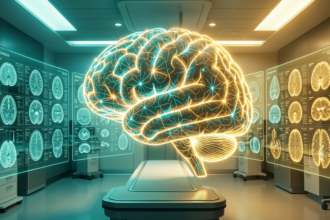
Researchers fused synthetic brain scans with a multi-model network to classify dyslexia in children using only 58 MRI images.

MedSpark Staff
By
msadmin
MedSpark Staff
Bymsadmin
Medical, Healthcare, & Biotech/Pharma AI News
Follow:
Published: October 10, 2026
Share
2 Min Read
SHARE

Dyslexia and isolated spelling deficits quietly undermine schooling in millions of children of normal intelligence. The earlier they are identified, the more effective intervention becomes. The trouble is timing, and the tooling behind it.

Structural MRI can reveal neurobiological signatures of reading difficulty, but training a reliable classifier needs large, well-labeled datasets. Assembling those is extraordinarily hard when subjects are children and the diagnostic categories are subtle.

A study in Neural Computing and Applications works around that bottleneck. Researchers S. Santhiya and C. S. Kanimozhiselvi at Kongu Engineering College in Tamil Nadu built a framework called MedFusionNet that attacks the data problem from two directions at once.

Two fixes for one small dataset

The first is generative. Rather than waiting for thousands of scans, the team synthesized additional training data to expand a small pool. The second is architectural, fusing several neural network designs into one decision-making system so no single model carries the whole judgment.

The dataset, drawn from the public OpenNeuro repository, held just 58 high-resolution scans: 22 typically developing children, 16 with isolated spelling deficits and 20 with dyslexia. Fifty-eight images is a vanishingly small amount for deep learning, and the class imbalance makes it harder still.

Despite that, MedFusionNet classified pediatric brain MRI scans with 96 percent accuracy. The approach suggests a path for other rare or hard-to-collect pediatric datasets, where generative augmentation and ensemble fusion together substitute for volume that simply does not exist.


TAGGED:diagnosticsGenerative AIMachine LearningMedical ImagingNeuroimagingpediatrics
SOURCES:Bioengineer.org
Share This Article
Facebook Copy Link Print
MedSpark Staff
Bymsadmin
Follow:
Medical, Healthcare, & Biotech/Pharma AI News

You Might Also Like

News & Alerts

AI takes center stage in 2026 Prix Galien USA nominee list

By
msadmin
August 26, 2026
News & Alerts

Taipei Hospital Unveils World-First AI Platform for Diagnosing Schizophrenia With Over 90% Accuracy

By
Yu Chi Huang
July 2, 2025
News & Alerts

FDA gives first US clearance to Vitestro’s vein-finding blood draw robot

By
msadmin
August 20, 2026
ArticlesNews & Alerts

Michigan Medicine neuroimaging model outperforms GPT in brain scan analysis

By
msadmin
July 12, 2026

AI news, analysis, and insights for healthcare, biotech, and pharma.

Facebook Twitter Youtube Linkedin
Quick Links
  • News & Alerts
  • Articles
  • Spotlight
  • Events
About Medspark
  • Mission
  • Services
  • Contact

© Copyright 2026 MedSpark. All rights reserved.

Privacy Policy | Legal