A short sentence spoken into a smartphone may carry enough information to flag type 2 diabetes. Researchers at Klick Labs reported on October 19 in the IEEE Journal of Biomedical and Health Informatics that a spectrogram-based model reached balanced accuracy of 71.3% for women and 72.4% for men.
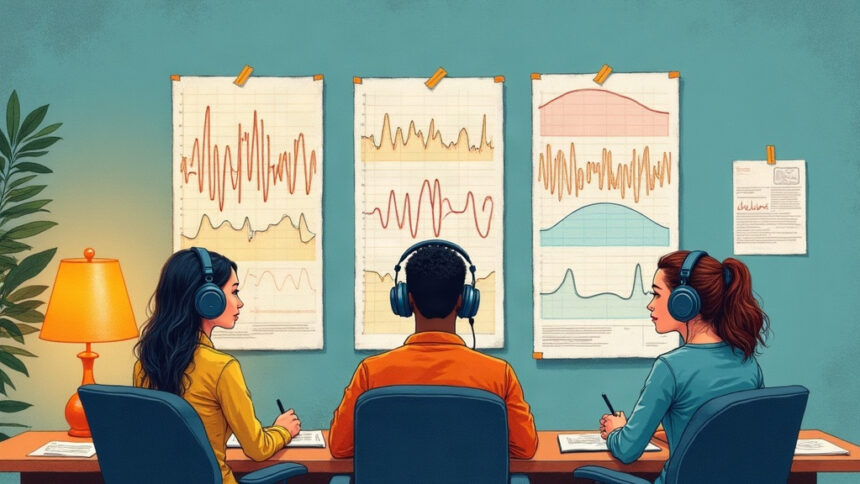
The team converted 14,759 voice recordings from 461 adults into visual maps of sound frequencies, then fed those images to an Audio Spectrogram Transformer. Participants read randomly selected short English sentences; sex was the only other input.
Why an image beats a feature list
Earlier vocal biomarker work leaned on predefined acoustic properties – pitch, shimmer, jitter, intensity. That approach forces researchers to guess which measurements matter before the model sees any data.
Reading spectrograms lets the transformer learn combinations of acoustic patterns across both frequency and time that nobody had specified in advance. Yan Fossat, senior vice president of digital health R&D at Klick Applied Sciences, said the team could see clues in vocal biomarkers that had not been on anyone’s radar.
AUC values landed at 0.788 for women and 0.779 for men.
A number that is not a record
Klick’s 2023 voice study reported conventional accuracy of 89% for women and 86% for men, which looks better and is not comparable. Balanced accuracy averages sensitivity and specificity, so it drops sharply when one class is harder to detect.
The authors were direct that the two figures should not be read against each other. Different inputs, different validation, different datasets.
The work is exploratory, not a screening product. Klick is also running vocal biomarker studies with Mayo Clinic in Florida across chronic disease.