The bottleneck in AI-driven biology is no longer the model. It is the pipette.
Opentrons Labworks closed a $40M Series E led by healthcare investor Avego, with BroadOak Capital Partners joining. The money goes toward robotics, software and data infrastructure rather than any single instrument.
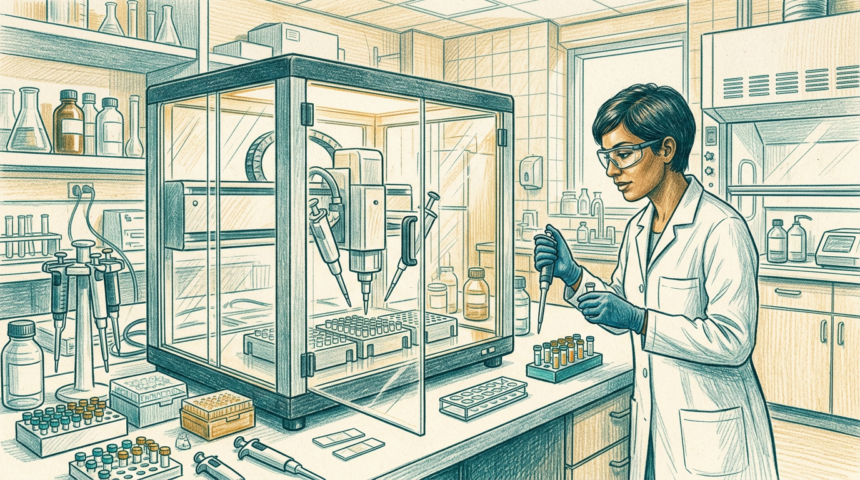
The Brooklyn company builds benchtop robots that move small volumes of liquid between samples inside transparent enclosures. Its Flex and OT-2 platforms handle DNA extraction, PCR, protein purification and ELISA work, the repetitive tasks that consume a scientist’s day.
Chief executive James Atwood put the case plainly, noting that millions of scientists spend most of their hours on manual work a robot could absorb. Returning that time to discovery is, in his framing, the largest opportunity in the field.
The strategic bet is autonomous science. Opentrons wants AI models to design an experiment, run it on a robot and learn from what comes back, looping without a human at the bench. Flex supports that with an optional gripper that shuffles plates between steps.
Scale is already substantial. The company reports more than 11,000 robots deployed across over 80 countries, including at 90% of the top 20 pharmaceutical companies. That installed base is the real asset for anyone collecting training data from real experiments.
James Flexner of Avego argued that drug developers and AI companies are both pushing toward automated workflows that yield usable data, and that autonomous science will converge on whichever platform already sits in the labs.
Earlier this year Opentrons said it was generating training data for physical AI-enabled laboratory robotics. The Series E funds extend that push into new markets and geographies.