

By using this site, you agree to the Privacy Policy and Terms of Use.
Accept
MedsparkMedsparkMedspark
  • Home
  • News & Alerts
    News & AlertsShow More
    Boehringer bets up to $1B on RNA splicing targets from Envisagenics
    By
    msadmin
    September 22, 2026
    AbbVie signs a multi-year AI deal as Iambic files for Nasdaq
    By
    msadmin
    September 22, 2026
    Heidi’s clinical AI now handles 2.8M patient visits a week
    By
    msadmin
    September 22, 2026
    a2z Radiology clears FDA for 10 more findings on abdominal CT
    By
    msadmin
    September 22, 2026
    LeCun and Moderna founder Langer join a cell modeling startup
    By
    msadmin
    September 22, 2026
  • Spotlight
    SpotlightShow More
    Robinhood Ventures Fund II brings retail capital to healthcare AI
    By
    msadmin
    August 13, 2026
    Adialante brings accessible MRI-based cancer screening
    By
    msadmin
    August 11, 2026
    CellType models biology so AI can discover drugs
    By
    msadmin
    August 11, 2026
    Healthcare AI startups in Robinhood Ventures Fund II
    By
    msadmin
    August 11, 2026
    OpenAI launches GPT-Rosalind for life sciences research
    By
    msadmin
    July 17, 2026
  • Articles
    ArticlesShow More
    Proteomics model picks breast cancer drugs from biopsies
    By
    msadmin
    September 10, 2026
    CRISP model reads frozen sections to steer cancer surgery
    By
    msadmin
    September 10, 2026
    Consumer chatbots are building a medical system outside hospitals
    By
    msadmin
    August 21, 2026
    Reasoning gaps hold back AI agents in scientific discovery
    By
    msadmin
    August 11, 2026
    Benchmark scores can’t track real clinical LLM use, Stanford says
    By
    msadmin
    August 11, 2026
  • About
    • Mission
    • Services
    • Contact
  • Shop
    • All Items
    • By Category
    • Cart
  • Newsletter
Font ResizerAa
MedsparkMedspark
Font ResizerAa
  • Home
  • News & Alerts
  • Spotlight
  • Articles
  • About
  • Shop
  • Newsletter
  • Home
  • News & Alerts
  • Spotlight
  • Articles
  • About
    • Mission
    • Services
    • Contact
  • Shop
    • All Items
    • By Category
    • Cart
  • Newsletter
Follow US
News & Alerts

Silicon Quantum Chip Breakthrough Opens Path to Secure Healthcare Data Processing

MedSpark Staff
By
msadmin
MedSpark Staff
Bymsadmin
Medical, Healthcare, & Biotech/Pharma AI News
Follow:
Published: June 17, 2026
Share
2 Min Read
SHARE

A Manufacturing Milestone for Quantum Computing

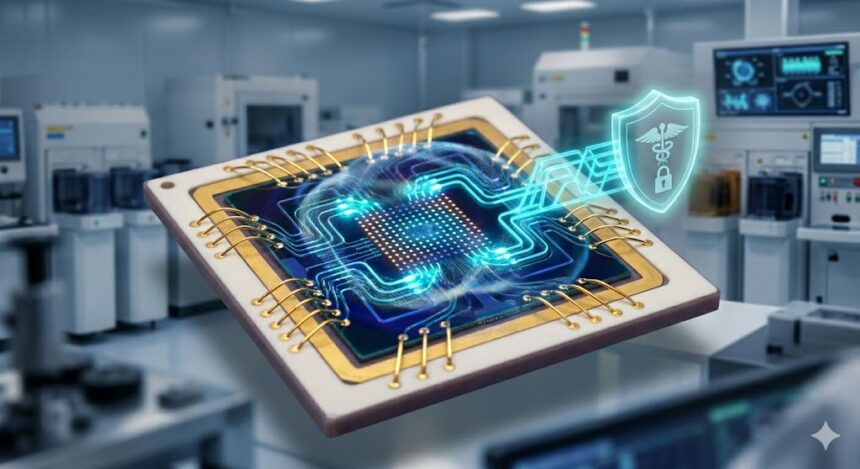
Researchers at UNSW Sydney-based startup Diraq, in collaboration with European nanoelectronics institute imec, have demonstrated that silicon-based quantum chips can maintain over 99% fidelity in two-qubit operations even when produced using standard semiconductor fabrication processes. Published in Nature on September 24, 2025, this achievement proves that quantum processors are no longer confined to pristine laboratory conditions. By leveraging existing chipmaking infrastructure, the path to cost-effective, utility-scale quantum computers has become significantly clearer, with implications far beyond academic research.

Contents
A Manufacturing Milestone for Quantum ComputingImplications for Healthcare Data Security and ComputationWhat This Means for Hospital Security Teams

Implications for Healthcare Data Security and Computation

For healthcare organizations, this breakthrough carries profound significance. Quantum computers capable of solving problems beyond the reach of classical supercomputers could transform drug discovery, genomic analysis, and medical imaging diagnostics. More critically from a security standpoint, the same quantum properties that enable powerful computation also underpin quantum-resistant cryptography. As healthcare systems increasingly store and transmit sensitive patient data (ePHI), the eventual deployment of fault-tolerant quantum processors will demand new encryption standards. Hospital CISOs and health IT directors should monitor this development as a signal to begin planning for post-quantum cryptographic transitions, ensuring that patient data protected today remains secure against future quantum-enabled decryption attempts.

What This Means for Hospital Security Teams

While utility-scale quantum computers remain years away, the demonstrated compatibility with existing semiconductor manufacturing accelerates the timeline. Healthcare compliance officers and medical device security engineers should view this as a driver for updated risk assessments under HIPAA and HITECH frameworks. The same chip fabrication lines producing current processors could soon yield quantum chips, potentially embedding quantum capabilities into medical devices, IoT sensors, and hospital infrastructure sooner than anticipated. Health system CISOs should proactively engage with standards bodies working on quantum-safe protocols and begin inventorying systems that handle long-lived sensitive data, as these will require early migration to quantum-resistant algorithms to maintain patient confidentiality and regulatory compliance.

Source: Sciencedaily

TAGGED:CryptographyePHIPatient DataQuantum ComputingSemiconductor
Share This Article
Facebook Copy Link Print
MedSpark Staff
Bymsadmin
Follow:
Medical, Healthcare, & Biotech/Pharma AI News

You Might Also Like

News & Alerts

Queen of Hearts ECG AI wins FDA nod for heart attacks

By
msadmin
September 7, 2026
News & Alerts

RapidAI ships EdgeIQ to match scans to models during image acquisition

By
msadmin
September 12, 2026
News & Alerts

New AI Model Accurately Detects Liver Tumors From Small Datasets, Revolutionizing Cancer Imaging

By
Yu Chi Huang
June 17, 2025
News & Alerts

Ant Group turns physician platform into AI workstation

By
msadmin
August 16, 2026

AI news, analysis, and insights for healthcare, biotech, and pharma.

Facebook Twitter Youtube Linkedin
Quick Links
  • News & Alerts
  • Articles
  • Spotlight
  • Events
About Medspark
  • Mission
  • Services
  • Contact

© Copyright 2026 MedSpark. All rights reserved.

Privacy Policy | Legal