By using this site, you agree to the Privacy Policy and Terms of Use.
Accept
MedsparkMedsparkMedspark
  • Home
  • News & Alerts
    News & AlertsShow More
    CureBay lands Rs 100 crore to grow AI-linked clinics across rural India
    By
    msadmin
    October 22, 2026
    Toronto team builds an open data engine for peptide drugs
    By
    msadmin
    October 22, 2026
    Eko puts an AI murmur detector in a stethoscope clinicians already own
    By
    msadmin
    October 22, 2026
    Astellas pays over $400M up front for proteins built from scratch
    By
    msadmin
    October 22, 2026
    AstraZeneca hands Oracle Health a role in finding trial patients
    By
    msadmin
    October 22, 2026
  • Spotlight
    SpotlightShow More
    Robinhood Ventures Fund II brings retail capital to healthcare AI
    By
    msadmin
    August 13, 2026
    Adialante brings accessible MRI-based cancer screening
    By
    msadmin
    August 11, 2026
    CellType models biology so AI can discover drugs
    By
    msadmin
    August 11, 2026
    Healthcare AI startups in Robinhood Ventures Fund II
    By
    msadmin
    August 11, 2026
    OpenAI launches GPT-Rosalind for life sciences research
    By
    msadmin
    July 17, 2026
  • Articles
    ArticlesShow More
    Proteomics model picks breast cancer drugs from biopsies
    By
    msadmin
    September 10, 2026
    CRISP model reads frozen sections to steer cancer surgery
    By
    msadmin
    September 10, 2026
    Consumer chatbots are building a medical system outside hospitals
    By
    msadmin
    August 21, 2026
    Reasoning gaps hold back AI agents in scientific discovery
    By
    msadmin
    August 11, 2026
    Benchmark scores can’t track real clinical LLM use, Stanford says
    By
    msadmin
    August 11, 2026
  • About
    • Mission
    • Services
    • Contact
  • Shop
    • All Items
    • By Category
    • Cart
  • Newsletter
Font ResizerAa
MedsparkMedspark
Font ResizerAa
  • Home
  • News & Alerts
  • Spotlight
  • Articles
  • About
  • Shop
  • Newsletter
  • Home
  • News & Alerts
  • Spotlight
  • Articles
  • About
    • Mission
    • Services
    • Contact
  • Shop
    • All Items
    • By Category
    • Cart
  • Newsletter
Follow US
News & Alerts

Toronto team builds an open data engine for peptide drugs

Google.org is funding OpenPep, an effort to generate the peptide binding data that AI drug design has never had.

MedSpark Staff
By
msadmin
MedSpark Staff
Bymsadmin
Medical, Healthcare, & Biotech/Pharma AI News
Follow:
Published: October 22, 2026
Share
2 Min Read
SHARE

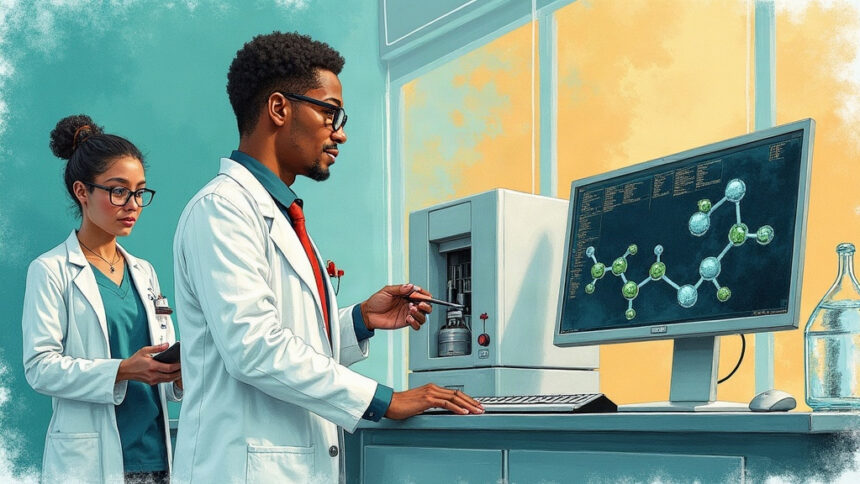
A peptide molecule that might one day treat a rare cancer or a neurodegeneration case has something a small-molecule tablet does not: the researchers hunting for it usually begin with no shared map of what has already been tried. Peptides make up about eight percent of newly approved medicines, and the University of Toronto wants to change how the next ones get found. With $2.3M from Google.org, its team is building OpenPep, an open platform for peptide drug discovery.

Data is the bottleneck. Structural biology got AlphaFold because researchers spent decades dropping experiments into public repositories. Peptides have no comparable commons, so every new campaign starts at zero.

The lead is Brown, an assistant professor at the Leslie Dan Faculty of Pharmacy. Joining him are Pardee and Kim from the same university plus ProteinQure’s Chris Ing. The money arrives through Google.org’s Impact Challenge: AI for Science.

Rather than wait for data, the group intends to manufacture it. Up to 500 proteins tied to disease will come out of Pardee’s cell-free synthetic biology work. Brown’s team then subjects large peptide libraries to mass spectrometry, recording which compounds bind and how tightly.

Each measured interaction turns into a training example. Models trained on the resulting corpus should eventually rank binding for targets no lab has touched, converting thousands of one-off experiments into rules that generalize.

Clinicians and drug developers get a vote on priorities. The team is crowdsourcing which proteins to pursue, favoring pediatric and rare disease, cancer, neurodegeneration and cardiovascular conditions, and anyone can submit a target through the project’s website.

Brown keeps expectations grounded. AI will not replace experiments, he said. Its job is to pick better ones by ranking which peptides deserve a bench.

TAGGED:drug discoveryGoogle.orgopen sciencePeptide Therapeuticsprotein designUniversity of Toronto
SOURCES:Bioengineer.org
Share This Article
Facebook Copy Link Print
MedSpark Staff
Bymsadmin
Follow:
Medical, Healthcare, & Biotech/Pharma AI News

You Might Also Like

News & Alerts

Aignostics ships a clinical grade pathology suite for research labs

By
msadmin
October 16, 2026
News & Alerts

NVIDIA and Foxconn Deploy Specialized AI Agent Workforces Across Taiwan Medical Centers

By
msadmin
June 19, 2026
News & Alerts

GE HealthCare rolls out AI breast ultrasound pair for dense tissue screening

By
msadmin
August 5, 2026
News & Alerts

CMS proposes new payment structure for clinical AI software

By
msadmin
July 17, 2026

AI news, analysis, and insights for healthcare, biotech, and pharma.

Facebook Twitter Youtube Linkedin
Quick Links
  • News & Alerts
  • Articles
  • Spotlight
  • Events
About Medspark
  • Mission
  • Services
  • Contact

© Copyright 2026 MedSpark. All rights reserved.

Privacy Policy | Legal