By using this site, you agree to the Privacy Policy and Terms of Use.
Accept
MedsparkMedsparkMedspark
  • Home
  • News & Alerts
    News & AlertsShow More
    Beijing’s BioGeometry passes $100M to design antibodies from scratch
    By
    msadmin
    October 29, 2026
    Brainomix finds a routine CT signal for stroke drug responders
    By
    msadmin
    October 29, 2026
    Cornell professors win FDA clearance for a brain artery reader
    By
    msadmin
    October 29, 2026
    Flagship folds three biotechs into Etcelera to predict drug behaviour
    By
    msadmin
    October 29, 2026
    Samsung wins Korean clearance to grade sleep apnea by the hour
    By
    msadmin
    October 28, 2026
  • Spotlight
    SpotlightShow More
    Robinhood Ventures Fund II brings retail capital to healthcare AI
    By
    msadmin
    August 13, 2026
    Adialante brings accessible MRI-based cancer screening
    By
    msadmin
    August 11, 2026
    CellType models biology so AI can discover drugs
    By
    msadmin
    August 11, 2026
    Healthcare AI startups in Robinhood Ventures Fund II
    By
    msadmin
    August 11, 2026
    OpenAI launches GPT-Rosalind for life sciences research
    By
    msadmin
    July 17, 2026
  • Articles
    ArticlesShow More
    Brain implant decoders fail when patients or hardware change, review warns
    By
    msadmin
    October 25, 2026
    Proteomics model picks breast cancer drugs from biopsies
    By
    msadmin
    September 10, 2026
    CRISP model reads frozen sections to steer cancer surgery
    By
    msadmin
    September 10, 2026
    Consumer chatbots are building a medical system outside hospitals
    By
    msadmin
    August 21, 2026
    Reasoning gaps hold back AI agents in scientific discovery
    By
    msadmin
    August 11, 2026
  • About
    • Mission
    • Services
    • Contact
  • Shop
    • All Items
    • By Category
    • Cart
  • Newsletter
Font ResizerAa
MedsparkMedspark
Font ResizerAa
  • Home
  • News & Alerts
  • Spotlight
  • Articles
  • About
  • Shop
  • Newsletter
  • Home
  • News & Alerts
  • Spotlight
  • Articles
  • About
    • Mission
    • Services
    • Contact
  • Shop
    • All Items
    • By Category
    • Cart
  • Newsletter
Follow US
News & Alerts

Cornell professors win FDA clearance for a brain artery reader

Deep Reasoning AI's NeuroDR cleared the FDA in 105 days without a pre-submission meeting, automating the anatomy cleanup that radiology labs now largely handle by hand.

MedSpark Staff
By
msadmin
MedSpark Staff
Bymsadmin
Medical, Healthcare, & Biotech/Pharma AI News
Follow:
Published: October 29, 2026
Share
2 Min Read
SHARE

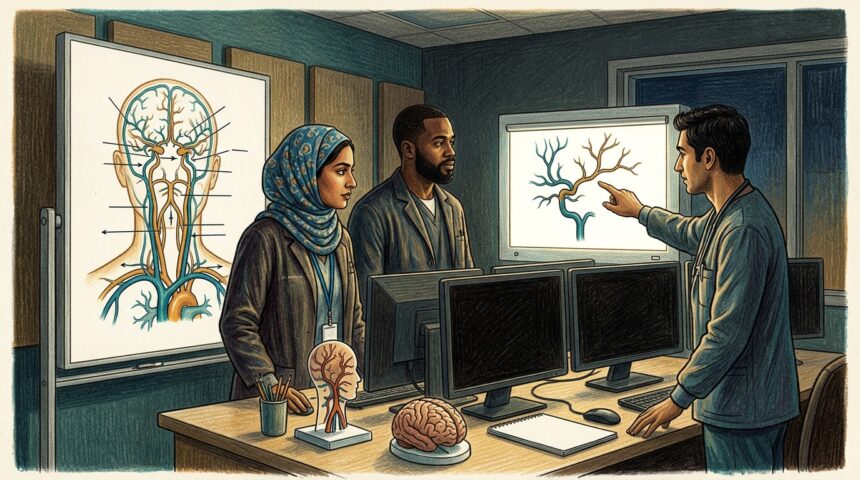
Reading a head and neck CT angiogram usually means waiting on a separate post-processing team to strip bone and veins, and that step now has an FDA-cleared shortcut. Deep Reasoning AI, founded by Cornell University artificial intelligence professors, won 510(k) clearance on October 27 for NeuroDR, software that renders the arteries of the head and neck from CTA scans.

The clearance, number K262134, covers a tool running in the background the moment a scan finishes. What returns to the hospital picture archive as DICOM files are curved reformats, volume renderings and 3D maximum intensity projections of the internal carotid and vertebral arteries on both sides. That means separating bone, soft tissue and veins first. Front and back flow stay in separate views, so neither hides anatomy within the other.

The cleared role is assistive. NeuroDR helps a doctor confirm whether a lesion they already spotted is present or absent, and supports follow-up plans and documentation. It does not hunt for lesions alone, which keeps the product in imaging AI’s assistive tier.

The imaging work was joint. Performance studies came from 3DR Labs, which calls itself the biggest 3D medical image post-processing provider in the United States, and NeuroDR was built with it. Innolitics, a medical device software and regulatory consultancy, shaped those studies and drafted the filing and cybersecurity paperwork. It knew what the agency expected from similar cleared devices, so NeuroDR skipped the pre-submission meeting and got a decision 105 days after filing.

Deep Reasoning AI chief executive Mike Beck called it the company’s first cleared product and a step toward full patient-specific 3D anatomy from routine scans. Innolitics partner Yujan Shrestha, MD, credited a client ready to do the work FDA asks for. Both firms plan to bring it to U.S. hospitals and imaging centers.


TAGGED:CT angiographyDeep Reasoning AIFDA 510(k)InnoliticsMedical Imaging AINeurovascular imagingstroke care
SOURCES:Business Wire via AOL
Share This Article
Facebook Copy Link Print
MedSpark Staff
Bymsadmin
Follow:
Medical, Healthcare, & Biotech/Pharma AI News

You Might Also Like

News & Alerts

Wireless Retinal Implant Restores Reading Ability in Macular Degeneration Patients

By
msadmin
June 17, 2026
News & Alerts

Mayo Clinic AI finds drug path to ‘undruggable’ cancer protein

By
msadmin
August 12, 2026
News & Alerts

Polyphron collects $20M to test drugs on lab-grown human tissue

By
msadmin
October 13, 2026
News & Alerts

Archy adds $50M to put agents to work in dental back offices

By
msadmin
September 13, 2026

AI news, analysis, and insights for healthcare, biotech, and pharma.

Facebook Twitter Youtube Linkedin
Quick Links
  • News & Alerts
  • Articles
  • Spotlight
  • Events
About Medspark
  • Mission
  • Services
  • Contact

© Copyright 2026 MedSpark. All rights reserved.

Privacy Policy | Legal