
Google DeepMind has turned its DNA model into an open map of the human genome. The AlphaGenome Atlas, released September 8, predicts the effects of all nine billion possible single-letter DNA changes and serves them up through a searchable, one-petabyte resource that requires no coding skills.
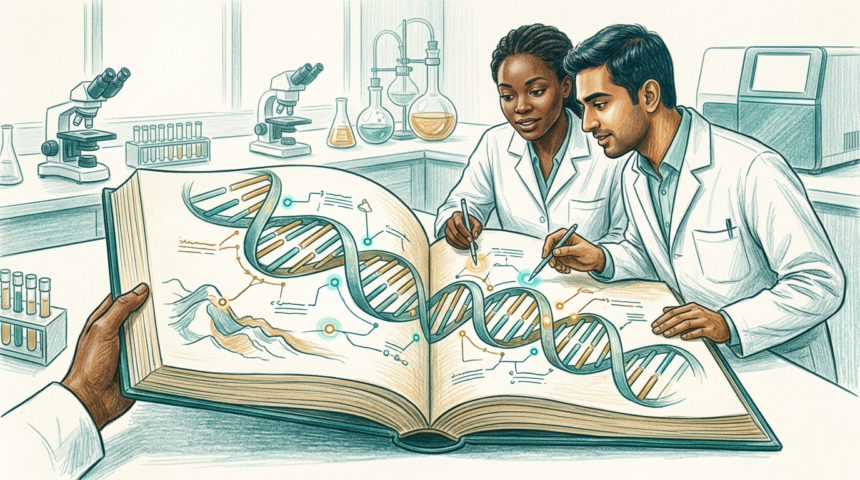
The atlas is built on AlphaGenome, the model DeepMind launched last year. Roughly 9,000 researchers have already pulled variant predictions through its programming interface, but product manager Dhavi Hariharan says writing code kept many biologists away. The new format lets scientists browse results the way they would flip through a physical atlas.
Each entry now carries a single AlphaGenome Variant Impact (AVI) score that ranks how much a change is likely to matter. In a test with the GREGoR Consortium, the scores flagged a variant in the DNM1 gene linked to a severe childhood brain disorder and pointed to the mechanism: the change created an incorrect splice site that lengthened the resulting protein. DeepMind and academic partners, including the Broad Institute, describe the work in a preprint released alongside the atlas.
The resource also covers more than 100 million short insertions and deletions seen in human genomes. DeepMind modeled the effort on its AlphaFold database, whose protein predictions have been used by millions of researchers, and offers the atlas free for non-commercial use.
Scientists caution that the scores are predictions, not verdicts. Martin Kircher of the Max Delbruck Center for Molecular Medicine in Berlin says the atlas will not replace experiments or individual-level diagnosis, calling it a useful and generous way to scale access to a strong model.